The koi originally, common carp had been breed in China since the 5th century B.C.E. as food however the common carp was bred in 1820 by the Japanese in or around Ojiya in the Niigata prefecture (prefecture are governmental bodies larger than cities, towns, and villages) on the north eastern coast of Honshu island for color. By the 20th century several color patterns had been developed in particular most notably the red-and-white Kohaku.
Like any other type of pet, people find it fun and popular to give their pet Koi treats. You might delight in seeing your Koi respond to treats while you, your children, or grandchildren feed them. While this is a great bonding experience between pet and owner, some precautions should be taken.
Koi will eat pretty much anything that you put in the pond with them, no matter if it is good for them or not. Since Koi do not have a sense of what is bad and good for them, as their owner you must control their snack diet.
Another potential problem is over feeding treats. Again, Koi do not have the knowledge to know when to stop eating, and weight issues may come from overfeeding none nutritional foods.
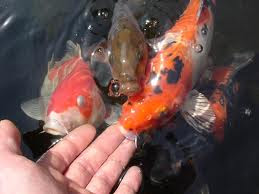
Learn to Hand Feed
However, if you feel that your Koi deserves treats, there are many types of foods that are available that may contain nutritional value, and will not harm your Koi in any way.
Natural Koi Treats- The best type of treat to feed your Koi is what they would find naturally in their pond. Things such as earthworms, tadpoles, and bloodworms are found in ponds, and may be eaten by your Koi without your knowledge.
The best way to find out what natural treats are available is just to look around the pond. Once you know what it out there, then you can either dig up the treats from the ground around the pond or buy similar products at your local store.
Prawns- Prawns are edible crustaceans which are similar to shrimp, but are usually larger. Prawns are actually very good for Koi because they are high in Protein. You can find prawns at a number of places including your local pet stores, department stores, and feed stores.
Prawns are available in regular and frozen, but be sure if you buy frozen to completely thaw it out before giving it to your Koi. Prawns are also one of the best treats to promote hand feeding.
Hand Feeding Koi
Lettuce- Lettuce is high in essential vitamins and minerals, and it quite healthy for your Koi. There is no need to tear the lettuce in smaller pieces as the Koi can find joy in doing it themselves.
Fruit- Koi will eat a wide variety of fruit. When feeding your Koi fruit, make sure to break the fruit up into small pieces. Fruit should only be fed to your Koi on special occasions, as most fruit contains high amounts of natural sugar, which can be bad for Koi in large amounts.
Bread- One of the cheapest treats available is Wheat Bread. Take a piece of bread, break it up, and roll it into small balls before throwing it into the pond. Be sure to avoid all types of white bread, as it may contain small amounts of bleach and other chemicals that can potentially be dangerous to your Koi.
No matter what type of treat you decide to use, it is still very important that you do not over do it. Too many treats and interfere with their diets, and cause more harm then good. Just do not get carried away, and you will be set.
You should pay special attention to the certain foods such as corn, beans, and grapes, as they contain an outer casing, which cannot be properly digested if swallowed by Koi. If you must feed this type of foods to your Koi, be sure to completely remove the outer casings before giving it to your Koi.
Koi are expressive eaters. This means that they eat a lot for their relative size, relative to other fish species. Koi can and will if allowed typically consume 2% of body weight per day even when fully grown which for any fish indicates veracious eater if you allow your koi to feed that much.
Fish like all animals need food to live, grow and flourish. Secure your koi the best food you need to know more about what you feed them.
Vegetables
Feed your Koi lettuce and grate carrots they float and Koi loves grated carrots and it is really good for them.
Feed you Koi fruit. Fruit is a good thing to feed your Koi because it provides a fresh source of vitamins and minerals. Vitamins and minerals in manufactured Koi food tend to break down after a couple of months. Feeding your Koi fresh fruit is a great guarantee that they are getting all of their nutrients.
It is also entertaining to watch your Koi swarm around the fruit and try to eat it. Be sure to wash the fruit with vegetable cleaner and scrub rind with stiff brush before you put it into a pond, there could be pesticides or chemicals on the skin.
Here are the three best fruits to feed your Koi: Do not feed Koi Grapes unless you want to remove the grape skin; the skin can not be digested by Koi this is how make fish food. Do not ever feed your Koi any corn based fish food. Koi fish food should have base of soy, wheatgerm etc. no corn.
Koi Eating Oranges
ORANGES
Oranges are a great source of Vitamin C. Oranges can be halved or quartered, and then put directly into the pond. Koi will swim behind the orange as a group so that they can each get a nibble of the pulp. Koi will eat everything except for the skin, this must later be removed from the pond.
LEMONS
Lemons are also a good source of Vitamin C. They can be halved or quartered, and then put directly into the pond. Koi will eat everything except for the skin, this must later be removed from the pond.
WATERMELON
Watermelon is a good fruit to feed Koi too. It should be cut into 2 – 3 inch pieces so that it can easily be eaten. Try to remove all, seeds, for Koi they can not not digest the seedsand seeds are very hard to remove from your pond. Koi are omnivorous and they have grinding teeth at the back of their mouths.
They are not piscivorous in that they do not eat other fish but they will eat small crustaceans, worms, larvae and the like that they like to dig up in the mud in their natural environment. They are natural bottom feeders although in Koi ponds they learn to surface feed very quickly.
They are natural bottom feeders although in Koi ponds they learn to surface feed very quickly.Here is some information that will help you choose the best food for your Koi fish special.
If possible, you should try to stick to feed nearly as possible what the Koi fish usually eat in the wild. Koi fish are voracious eaters. Koi are omnivorous and will consume almost anything that is available. Therefore, it is important to follow what they eat, in order to stay healthy.
You can choose between feeding live insects or commercially available Koi fish food, or you can give them the combination. In addition to their regular food, you can supplement your diet is occasionally as fresh foods and nutritional supplements.
As such their diet is highly varied in the wild, allowing them access to a wide range of habitats and contributing to the successful propagation of the species into just about every water course in the world.
It has in fact also contributed to the black listing of the species in many nations in the world, ours included. In South Africa, cyprinus carpio has been listed as an invasive species, with Koi requiring specialist regulation overseen by an industry body in order for it to be sold.
Some people do not choose the plants in their ponds koi because they are eating. However, you must make sure your Koi Fish for the balance of plants and koi fish food.
Koi food is less expensive if you base the food on dry. There are a variety of formats, such as pellets, granules, pieces, flakes and tablets. All these foods are easy to store and convenient.
When considering what type of Koi food to use, you should take into consideration the age and size of Koi. It 'also needs to consider the degree of their development and the season in the the year.
Spring Koi are ravenous remember your Koi have not eaten all winter other than picking at algae Summer requires a large amount of protein, because the energy levels are the highest.
During the winter, they are less active and need no food do not feed during the winter your Koi will pick at the algae.
You'll use less pellets for small fish and large particles of larger fish. Some people believe that certain foods to enhance the colors of their fish. This works in theory, but remembers that models are genetically red board. Red will not be significantly boosted by additional funding.
Supplementation may also improve your overall health and strengthen the immune system and the moth. Warning that is given too much can also be toxic.
Some koi fish feed already contains some supplements to read labels and check ingredients to make sure not to overdose your fish. It would be dangerous and even toxic.
Apart from commercially processed foods, you can balance the diet with fresh ingredients like lettuce. Your fish will love this treatment. Rake leaves and let it float on water. Romaine and leaf is preferred.
Another Fish Food Koi is fond of oranges. This is high in vitamin C and powerful anti-oxidant. Cut into wedges, leaving the shell intact.
Koi Fish Shrimp are a favorite. They are rich in protein and high in summer, when the Koi Fish needs more protein.
Insects and larvae as food will always be greeted by the koi. Mealworms, blood worms, black worms, wax worms, white worms, tubifex worms and soft-shelled crickets are generally preferred for Koi fish. Supervision and check your Koi Fish follow their development, health and welfare.
Koi will also consume a large quantity of vegetable matter such as algae and plants as anyone who has had unprotected plants in their pond will attest. But pretty much anything and everything that they can get into their mouths, Koi will eat.
Koi are thus relatively easy animals to feed. Herein lies potential danger however because as an aquatic life form the Koi's natural source of food lies within the aquatic eco-system. This means that the protein (amino acid profile), carbohydrate, fats and oils, mineral profile etc of the food you feed your Koi should reflect this.
Koi will adapt to eating dog food pellets if this is all they receive. However, this is not a long term solution as gaps in the nutritional profile requirements of a Koi will manifest themselves in deficiencies within the animal itself that will result in a long term compromise of the overall health of the Koi.
In other words, there may be small trace elements and essential amino acids and lipids that are missing that cause the Koi to develop abnormalities. These can sometimes be seen physically on the Koi and can manifest as bad body shapes, lumps in the Koi, poor color, poor luster, lethargy, tumors, cancers and all manner of physical ailments that we may or may not be able to diagnose.
The important word is thus 'balance'. Whatever you feed your Koi it needs to be along term nutritionally balanced Koi specific food. It is not a trout food modified to suit Koi - this cannot and does not work. It is not a Tilapia feed, similarly modified. It is also not green and red pellets comprised of wood shavings bound together by glue!
A good quality Koi food has costs. But it is necessary to maintain the long term health of your pets. And don't necessarily believe the labels on the side of the bag. We have seen too many times a food, reputable brands included, that report a 36% protein count, only to reflect a 12% content upon analysis!
There is NO legal requirement in South Africa to back claims on a label when it comes to Koi food, and unscrupulous vendors take advantage of this fact blatantly.
A good quality Koi food should and will cost . This is because the quality of the ingredients going into the food needs to meet a certain minimum standard. As sad as it maybe, price is a great indication of what you are getting in your food.
A bit of basic research online (you're doing it right now) will also tell you very quickly which foods to consider, and which to avoid like the plague!
Mazuri or Hikari Koi foods. What it is the world's best fish food manufacturers, particularly when it comes to Koi? You cannot get better, in providing Koi, with nothing less than the very best buy either Mazuri or Hikari fish foods they are the best Koi foods.


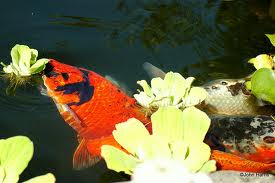


 Nishiki-ColorfulKoi Koi Eating Water Lettuce Koi are expressive eaters. This means that they eat a lot for their relative size, r...
 Koi Group Photo By en.wikipedia.org http://www.koi-bito.com/forum/main-forum/ Note-publish magazine/ large forum/ active htt...
 Tobi-Koi Fry - Photo By en.wikipedia.org Tobi What is tobi defined-Tobi: (Toe-Bee) jump ; in koi fry it refers to koi that jump ...
 Kuchibeni Also white and red (known as a "lipstick" Koi fish with a white body and red markings around the mouth) (is said to ins...
 New Butterfly Koi Domestically Bred-Ogkoi.com Butterfly Koi , Longfin Koi , or Dragon Carp are a type of ornamental fish notabl...
 Koi Herpes Virus short for KHV is a deadly virus , which can cause 80-100 percent mortality in common carp . The first outbreak of Koi H...
 Everyone would like cheaper bait at the moment and not too many angler care if it is highly nutritionally attractive or not for long-term su...
 Sexing koi- Photo By nishikigoi -info.com By Chiltern Koi Club Sexing Koi Fish Females, especially in season are far more round...
 What Causes Koi Cotton Fungus Cotton wool or cotton ball disease is the name for Saprolegnia — a dreadful fungus that grows when bad ...
 Cotton wool or cotton ball disease is a called Saprolegnia — a bad fungus that grows when bad water quality stresses your koi. Expect to fi...