The koi originally, common carp had been breed in China since the 5th century B.C.E. as food however the common carp was bred in 1820 by the Japanese in or around Ojiya in the Niigata prefecture (prefecture are governmental bodies larger than cities, towns, and villages) on the north eastern coast of Honshu island for color. By the 20th century several color patterns had been developed in particular most notably the red-and-white Kohaku.
Like any other type of pet, people find it fun and popular to give their pet Koi treats. You might delight in seeing your Koi respond to treats while you, your children, or grandchildren feed them. While this is a great bonding experience between pet and owner, some precautions should be taken.
Koi will eat pretty much anything that you put in the pond with them, no matter if it is good for them or not. Since Koi do not have a sense of what is bad and good for them, as their owner you must control their snack diet.
Another potential problem is over feeding treats. Again, Koi do not have the knowledge to know when to stop eating, and weight issues may come from overfeeding none nutritional foods.
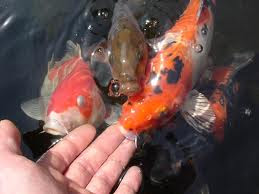
Learn to Hand Feed
However, if you feel that your Koi deserves treats, there are many types of foods that are available that may contain nutritional value, and will not harm your Koi in any way.
Natural Koi Treats- The best type of treat to feed your Koi is what they would find naturally in their pond. Things such as earthworms, tadpoles, and bloodworms are found in ponds, and may be eaten by your Koi without your knowledge.
The best way to find out what natural treats are available is just to look around the pond. Once you know what it out there, then you can either dig up the treats from the ground around the pond or buy similar products at your local store.
Prawns- Prawns are edible crustaceans which are similar to shrimp, but are usually larger. Prawns are actually very good for Koi because they are high in Protein. You can find prawns at a number of places including your local pet stores, department stores, and feed stores.
Prawns are available in regular and frozen, but be sure if you buy frozen to completely thaw it out before giving it to your Koi. Prawns are also one of the best treats to promote hand feeding.
Hand Feeding Koi
Lettuce- Lettuce is high in essential vitamins and minerals, and it quite healthy for your Koi. There is no need to tear the lettuce in smaller pieces as the Koi can find joy in doing it themselves.
Fruit- Koi will eat a wide variety of fruit. When feeding your Koi fruit, make sure to break the fruit up into small pieces. Fruit should only be fed to your Koi on special occasions, as most fruit contains high amounts of natural sugar, which can be bad for Koi in large amounts.
Bread- One of the cheapest treats available is Wheat Bread. Take a piece of bread, break it up, and roll it into small balls before throwing it into the pond. Be sure to avoid all types of white bread, as it may contain small amounts of bleach and other chemicals that can potentially be dangerous to your Koi.
No matter what type of treat you decide to use, it is still very important that you do not over do it. Too many treats and interfere with their diets, and cause more harm then good. Just do not get carried away, and you will be set.
You should pay special attention to the certain foods such as corn, beans, and grapes, as they contain an outer casing, which cannot be properly digested if swallowed by Koi. If you must feed this type of foods to your Koi, be sure to completely remove the outer casings before giving it to your Koi.
Koi ponds are nothing more than out door in your back or front yard aquarium that you so happen to keep Koi fish in.
For a Koi pond to actually function and sustain your Koi; unfortunately for you there are actual requirements you’re going too have to subscribe too sustain your pond much less Koi.
Remember all Koi are not restricted to the size of their aquarium; Koi grow and grow and grow all Koi are carp which is physically large sized specie of fish.
I will presume you have already built your pond and you have encountered problems; let me guess regarding your unforeseen problems; such as why does my pond smells bad and why is my pond greenish black?
Of course the answer is; We call that Bad luck- Can we all say in unison "an ounce of prevention is worth pound of cure” OK! I will stop being hateful.
The why is because you are over feeding, overstocking and the pond has turned over which mean there is no oxygen in the pond?
Does your pond look like this-DIRTY KOI POND
How to Koi Pond and Koi Pond Maintenance
Do the following; Move your Koi into a large well aerated tank make sure you have acclimate Koi into their new environment i.e. water and temperature, conditioned filters and do not feed Koi for at least 5 day’s after moving-remember is takes 4 days for Koi to completely digest food; any Koi that is diseased immediately place Koi in quarantinetank and do not treat until you know what you are treating for; remember more hobbyist, Koi are killed every year by the Shot Gun Medicating approach; call your vet or call the breeder you purchased your Koi from on what treatment you should employ.
OK! let’s move forward-(Koi pond should have no fish or any living thing left in the pond; that would include turtles, remove all aquatic plants place in holding tank for your aquatic plants; this would be tank you usually put your plants in the winter).
Drain pond or pump out the pond at least 50% of all pond water; make sure your pump hoses are lying on the bottom of the pond drain or pump out and focused on the bottom of the pond that’s where problems originated; I don't want to delude you pumping water out your Koi pond or draining you're Koi pond is really big job.
Pumping Water Out Of Koi Pond Is Big Job
Use high pressure water hose or nozzle attachment and wash down the sides of the pond- remove any rocks, water feature and water falls, skimmers, aeration stones, external pumps or UV filters external heaters, wash them down place in the sun let them dry for at least 24 hours.
Now start refilling pond add back all water features and turn on the pumps DO NOT put any rocks back in the pond-Ever;There are several articles posted on Nishiki-Colorful Koi on water and dolomite and water additives.
Question: Why do I have to remove the rocks? Rocks make the pond look natural and besides my wife picked out the rocks and she loves them.
Answer: Rocks collect debris-food and excrement; further it is impossible for your koi pond filtration to work properly because water flow is obstructed by the rocks.
Answer: As for your wife, have your wife clean out the pond, move the rocks, all water features, skimmer, fitters and move the koi and pump out and clean hosing down the pond and refilling the pond. Move the rocks and place rocks in the middle of you’re planting around the pond one or three rocks together and over lap the rock-always use rocks, in odd amounts-i.e. 1-3-5-7 etc...
Add additional filtration such as an additional bog filter and remember you are going to have to recondition your filters your filters MUST have good bacteria growing back in the filers this takes approximately 3 to 4 weeks to develop.
When you are able to transfer your Koi back in the pond anticipate the transfer cannot occur for 5 to 6 weeks; DO NOT OVER FEED- feed your Koi once a day and feed only enough food that they can consume in 5 to 10 minutesandDO NOT OVER STOCK Your Koi Pond;vacuum up any food that has sunk to bottom of pond, your skimmer should take care of the surface of the pond but if you have over fed use net to collect any surface food.
Remember maintaining a Koi pond can be a substantial amount of work but you can eliminate a massive amount of work through preventive maintenance and like with any other pets, issues will arise that will require additional and extra attention.
Now that it is summer time my Koi fish want to eat all the time. How much should do I feed my Koi and how often?
Answer:
First the Koi fish do want to eat all the time; that doesn’t mean Koi need food. When your Koi see you they want to eat, that’s a conditioned response.
Stick to Koi feeding schedule.
Spring –Starts at 50°F - wheat germ food once a day what Koi will eat in 5–10 minutes
Summer – Starts at about 60°F Regular high protein food once a day what they will eat in 5–10 minutes.
Koi pond temperature 65-70°F – Feed twice a day what they will eat in 5–10 minutes.
Koi pond temperature over 70°F – You could go to three times a day what they will eat in 5–10 minutes.
Koi pond temperatures over 80°F – Too Hot Do Not Feed look for ways to cool the water. Different kinds of pond chillers are available. I've seen coil based units that hang into the water as well as pumps which circulate the water into the unit then expel cooler water out.
Check your local hardware store in the garden section where they keep the lawn and swimming pool equipment or go to swimming pool store that's where you will find pond equipment in Las VegasNevada. Further add portable waterfall or fountain immediately why not do both. Remember hotter the pond’s temperature less air in the pond.
Fall – Do the schedule in reverse until 50°F. Then don’t feed; If you feed more than this you will be fouling the water and Over taxing your filter system, by making more ammonia. Don’t forget to do your water changes and ammonia testing on a regular schedule; this will help water quality stay high.




 Nishiki-ColorfulKoi Koi Eating Water Lettuce Koi are expressive eaters. This means that they eat a lot for their relative size, r...
 Koi Group Photo By en.wikipedia.org http://www.koi-bito.com/forum/main-forum/ Note-publish magazine/ large forum/ active htt...
 Tobi-Koi Fry - Photo By en.wikipedia.org Tobi What is tobi defined-Tobi: (Toe-Bee) jump ; in koi fry it refers to koi that jump ...
 Kuchibeni Also white and red (known as a "lipstick" Koi fish with a white body and red markings around the mouth) (is said to ins...
 New Butterfly Koi Domestically Bred-Ogkoi.com Butterfly Koi , Longfin Koi , or Dragon Carp are a type of ornamental fish notabl...
 Koi Herpes Virus short for KHV is a deadly virus , which can cause 80-100 percent mortality in common carp . The first outbreak of Koi H...
 Everyone would like cheaper bait at the moment and not too many angler care if it is highly nutritionally attractive or not for long-term su...
 Sexing koi- Photo By nishikigoi -info.com By Chiltern Koi Club Sexing Koi Fish Females, especially in season are far more round...
 What Causes Koi Cotton Fungus Cotton wool or cotton ball disease is the name for Saprolegnia — a dreadful fungus that grows when bad ...
 Cotton wool or cotton ball disease is a called Saprolegnia — a bad fungus that grows when bad water quality stresses your koi. Expect to fi...