Hand Feeding Your Koi
 |
| Hand Feed Your Koi |
One of the best features of Koi is their lack of fear for humans. Once the Koi understand that you are not going to harm them, and that you are the one who provides them food, they will likely eat right out of your hand with the right training. Hand feeding can be one of the funniest and most entertaining experiences.
Koi are none-aggressive fish. Koi do not have teeth, so you will not get bit if you decide to attempt to feed your Koi out of your hand. This even allows you to get smaller children involved. Smaller children will be delighted by the beautiful colors and gentle nature of the Koi.
Koi, like any other wild animal, will naturally be afraid of you in the beginning. Instincts tell them to be afraid of you, which is what keeps them alive in the wild. You must build up trust with your Koi, and this takes time and patience. You will not be able to hand feed over night.
 |
| Training Your Koi With Hand Feeding |
Koi are omnivorous fish, which means they will eat both meat and plants. This means that their diets are very versatile. Koi will eat pretty much anything that you put in the pond with them, no matter if it is good for them or not. Since Koi do not have a sense of what is bad and good for them, as their owner you must control their snack diet. Another potential problem is over feeding treats.
Again, Koi do not have the knowledge to know when to stop eating, and weight issues may come from overfeeding none nutritional foods. The healthiest treats for Koi are what they would find naturally in their ponds, such as earthworms and tadpoles, but it will not hurt to feed Koi treats such as lettuce, bread, fruit, and veggies.
You should pay special attention to the certain foods such as corn, beans, and grapes, as they contain an outer casing, which cannot be properly digested if swallowed by Koi. If you must feed this type of foods to your Koi, be sure to completely remove the outer casings before giving it to your Koi.
The trick is to start slow. Never make any sudden movements, as this will scare even the most trusting of fish. It will be best to begin hand training your fish from the very moment you get them, but it is not impossible to train a fish that you have had for awhile either.
 |
| Hand Feeding Your Koi |
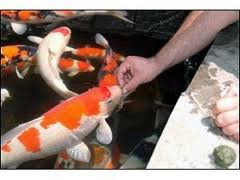
Begin by placing a few pellets or snacks in your hand and submerging your hand under water. Slowly allow the food to fall out of your hand into the water. The Koi may not seem to be paying by attention, but rest assured that they are aware of your hand, and are aware that you hand is providing the food. Do this for a couple of days.
After you have dropped the food into the pond for a couple of days, and have gained the interest of your Koi, begin making the fish remove the food from your hand. If the Koi refuse to take the food from your hand, do not feed them that day. You will not stare your fish in this process. They will quickly get the idea that if they want to eat, they must get the food from you. Doing this everyday will get them comfortable with you.
Once you have the fish eating out of your hand, then you can start getting your Koi to eat the food directly from your fingers. If the Koi will not take the food out of your fingers, do not feed them that day. Food is your number one motivator when it comes to wild animals, and no fish will simply stare itself because it is unsure of the situation.
Once your fish are comfortable with hand feeding, you can alternate between hand are regular feeding. If you are in a rush, there is no reason to attempt to take the time to hand feed. Also, once you get your Koi taking food from your hand, be careful when allowing visitors to feed your fish. Always supervise children and adults alike, making sure that they are feeding the fish proper foods, and not making any sudden movements that will scare the fish.


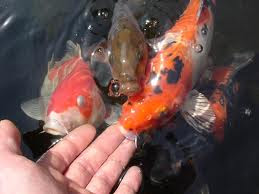
 Nishiki-ColorfulKoi Koi Eating Water Lettuce Koi are expressive eaters. This means that they eat a lot for their relative size, r...
 Koi Group Photo By en.wikipedia.org http://www.koi-bito.com/forum/main-forum/ Note-publish magazine/ large forum/ active htt...
 Tobi-Koi Fry - Photo By en.wikipedia.org Tobi What is tobi defined-Tobi: (Toe-Bee) jump ; in koi fry it refers to koi that jump ...
 Kuchibeni Also white and red (known as a "lipstick" Koi fish with a white body and red markings around the mouth) (is said to ins...
 New Butterfly Koi Domestically Bred-Ogkoi.com Butterfly Koi , Longfin Koi , or Dragon Carp are a type of ornamental fish notabl...
 Koi Herpes Virus short for KHV is a deadly virus , which can cause 80-100 percent mortality in common carp . The first outbreak of Koi H...
 Everyone would like cheaper bait at the moment and not too many angler care if it is highly nutritionally attractive or not for long-term su...
 Sexing koi- Photo By nishikigoi -info.com By Chiltern Koi Club Sexing Koi Fish Females, especially in season are far more round...
 What Causes Koi Cotton Fungus Cotton wool or cotton ball disease is the name for Saprolegnia — a dreadful fungus that grows when bad ...
 Cotton wool or cotton ball disease is a called Saprolegnia — a bad fungus that grows when bad water quality stresses your koi. Expect to fi...